Why does employee engagement dip in February and what should employers do about it?
January often starts strong, but February is where employee engagement quietly softens. This blog explores why the dip happens, the early warning signs HR teams should watch for and how to stabilise momentum before it affects utilisation, productivity and Q1 performance.
Jenny Hinde, Chief People Officer at Personal GroupWednesday 25 February 2026
Share on socials:

January is full of targets, town halls and renewed intent.
February is where good intentions quietly slip.
For many UK employers, February brings a noticeable drop in engagement, momentum and energy. The takeaway is simple: this dip is predictable, measurable and preventable if you design for it.
Why February is a pressure point for employee engagement
February sits in an awkward space in the workforce calendar.
The New Year reset has faded. Spring has not arrived. Pay review conversations may be looming. Budgets are under scrutiny. Operational pressure remains constant.
For HR and Reward leaders, this creates a predictable risk window.
The January illusion
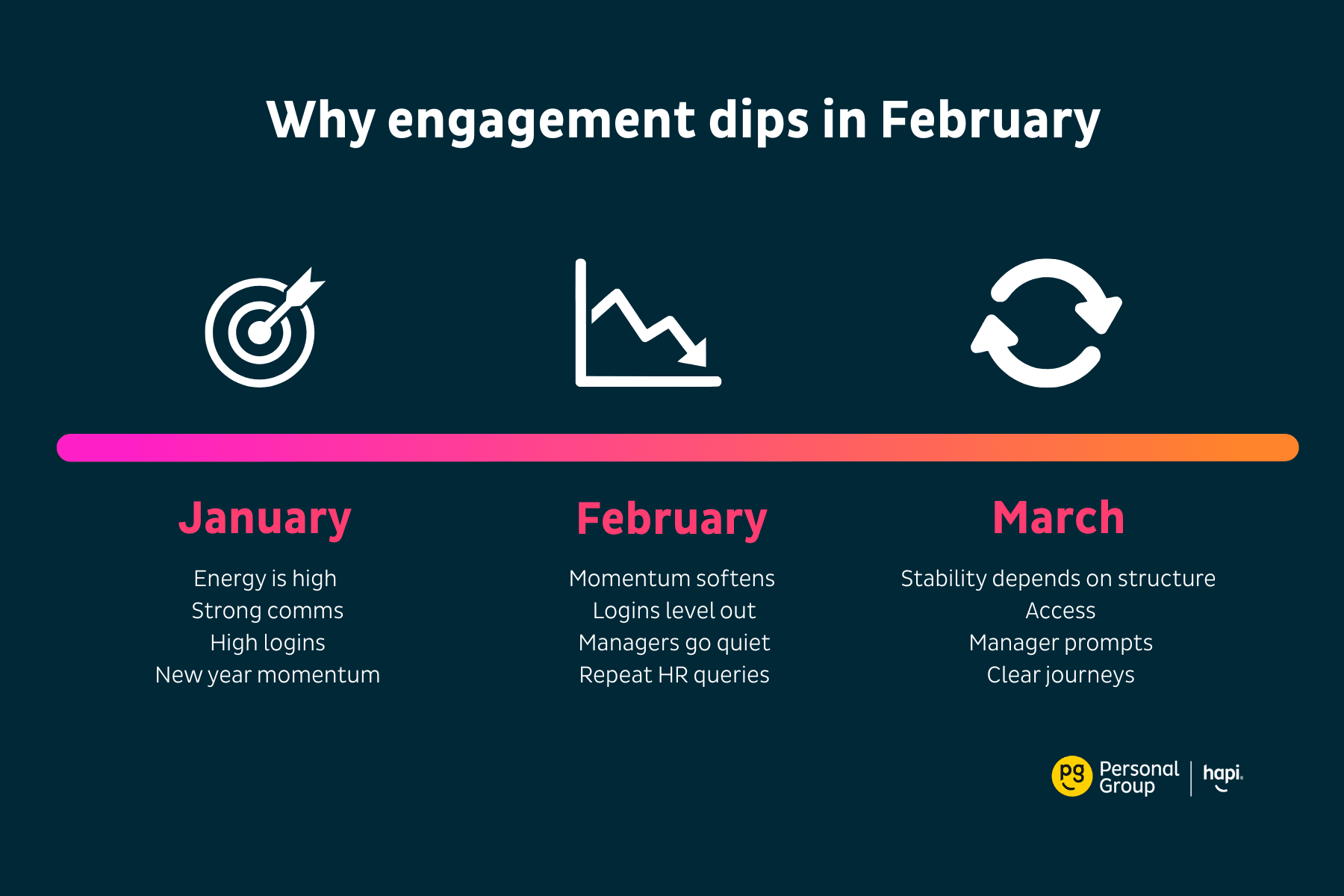
January often looks strong on paper:
- High town hall attendance
- Strong click-through on new year communications
- Renewed interest in wellbeing initiatives
- Positive manager messaging
But January engagement is often fuelled by novelty and narrative. February tests whether systems and structures support sustained behaviour.
When they do not, participation slows.
Energy without structure does not last
Many engagement plans rely on enthusiasm rather than architecture.
If access to benefits is fragmented, communication is one-size-fits-all or managers are unclear on their role, February exposes those gaps.
The issue is not motivation. It is friction.
What are the early signs of a February engagement dip?
If you look at your data in isolation, February can look like “normal variation”. Viewed in context, the signals are clearer.
Common indicators include:
- Drop in benefits platform logins
- Lower email engagement compared to January
- Reduced participation in optional wellbeing or recognition activity
- Increase in basic HR queries about existing benefits
- Managers reporting lower discretionary effort
This is where Signals – Decisions – Measures becomes useful.
Signal: Activity slows after January
Decision: Is the issue communication, access or relevance
Measure: Track logins, segment-level engagement and repeat HR queries weekly
Short review cycles matter in February. Waiting until Q2 hides preventable slippage.
Why this matters for UK employers
A short engagement dip may feel manageable. In reality, February behaviour often sets the tone for the quarter.
Lower engagement in February can mean:
- Reduced benefits utilisation
- Slower adoption of new initiatives
- Increased admin burden for HR
- Harder conversations with Finance about value
CIPD’s Good Work Index consistently highlights that communication, voice and perceived fairness drive engagement and retention in UK workplaces. When those elements weaken, so does momentum.
The risk is not one quiet month. The risk is compounding disengagement through Q1.
A practical framework to prevent the February employee engagement dip
This is not about adding more activity. It is about tightening structure.
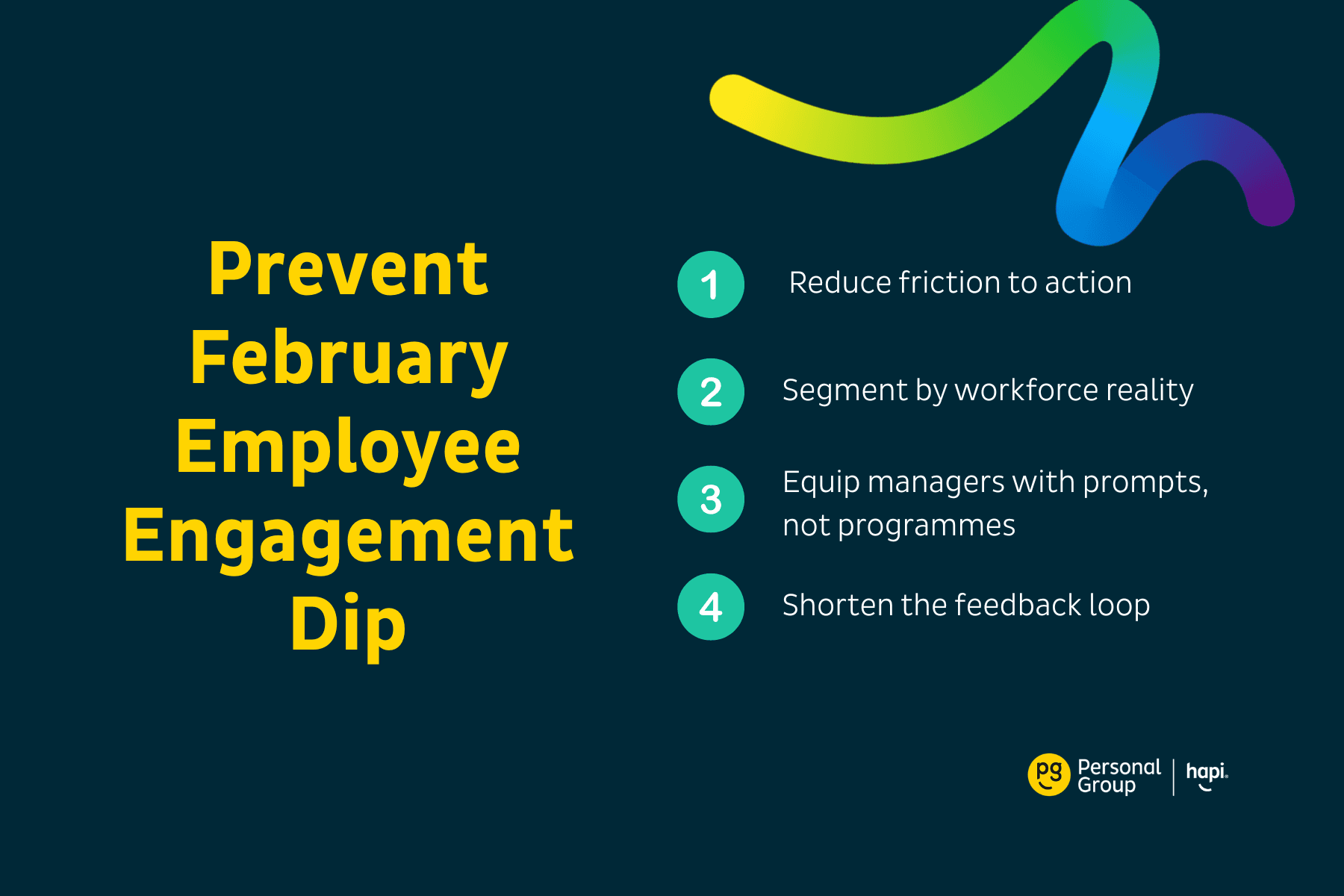
Step 1: Reduce friction to action
If employees need multiple logins, unclear instructions or manager sign-off to act, February fatigue wins.
Focus on:
- One clear access point for benefits and key information
- Short, specific calls to action
- Clear signposting for deskless and frontline employees
Friction compounds when energy dips.
Step 2: Segment by workforce reality
February engagement often drops faster among frontline or deskless teams.
Ask:
- Are communications accessible without a corporate email
- Is mobile access simple
- Are site-based employees receiving the same clarity as HQ teams
Fair access strengthens perceived fairness.
Step 3: Equip managers with prompts, not programmes
Managers are central to sustained engagement, but February is operationally heavy.
Provide:
- One-page prompts for key moments
- Short monthly messages they can reuse
- Clear answers to common benefit questions
If you make managers guess, they disengage first.
Step 4: Shorten the feedback loop
Review engagement signals weekly in February.
Track:
- Logins and activity by segment
- Uptake of priority benefits
- Repeat HR queries
- Manager feedback themes
Change one variable at a time and monitor impact.
What this looks like in practice
Picture a mid-sized UK organisation with a mix of office-based, hybrid and site-based employees. January starts strongly. New year messaging lands well. Logins increase. Managers reference the latest initiatives in team meetings.
By mid-February, the shift is more subtle.
Activity on the benefits platform begins to level off. Frontline teams are less responsive to internal messages. HR notices the same basic questions resurfacing about benefits that were already explained in January.
Nothing dramatic. No crisis. Just a quiet loss of momentum.
Left unchecked, that drift can carry through the rest of the quarter.
Week 1: simplify access points and highlight the most relevant actions for each workforce group
Month 1: re-focus communications around real moments that matter, not generic updates
Quarter 1: review engagement patterns by workforce segment and adjust based on what people are actually using.
The aim is not to create noise. It is to steady the system before small dips turn into sustained disengagement.
How to measure whether your February engagement strategy is working
Focus on movement, not perfection.
Key measures:
- Weekly active users on your benefits hub
- Engagement by workforce segment
- Completion of priority actions
- Reduction in repeat administrative queries
- Qualitative manager feedback
February success is visible in smaller drops and faster recovery curves.
Conclusion
February engagement dips are rarely about apathy. They are about friction, fairness and fatigue.
When employers design engagement systems that work beyond the January reset, February becomes a stability test rather than a warning sign.
If you want a structured review of how your engagement architecture holds up under February pressure, speak to a specialist for a practical walkthrough.
FAQs
Why does employee engagement dip in February?
Because the novelty of January initiatives fades and structural friction becomes more visible. Engagement systems, not motivation, determine sustainability.
Is a February engagement dip normal?
Short-term fluctuation is common. Sustained decline suggests issues with access, communication or perceived fairness.
Should we launch a new initiative to fix it?
Not immediately. Review access, segmentation and manager enablement first. Often the fix is simplification, not addition.
Does this affect frontline teams more?
Often yes. If communication and access rely heavily on email or intranet systems, deskless employees can disengage faster.